Don't Wait for the Exit Interview to Find Out Why They Left
StayRight® is HSD Metrics' outsourced stay interview and pulse survey program. We ask your current employees what's working, what isn't, and what would make them stay — while you still have time to act on their answers.
Annual Surveys Miss the Moments That Matter
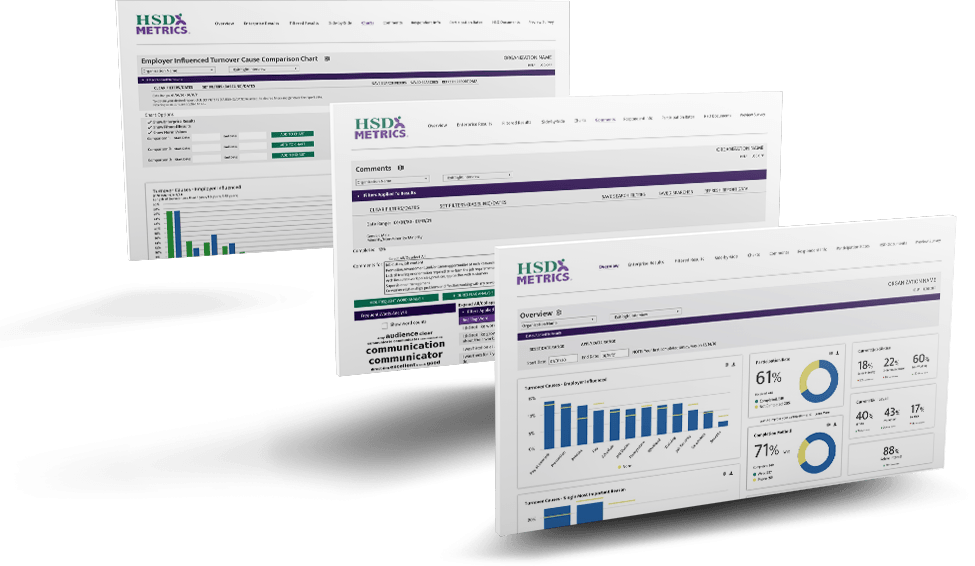
The typical engagement survey runs once a year but improvement initiatives, leadership changes, and policy adjustments happen continuously. By the time results are analyzed and shared, the organization has already moved on — and so have some of the employees who needed to be heard. Stay interviews and pulse surveys give you a continuous line of sight into the employee experience instead of a single annual snapshot.
StayRight® vs. Waiting for the Annual Survey
| Without StayRight® | With StayRight® |
|---|---|
| ✗One survey per year leaves long gaps between listening and acting | ✓Pulse surveys and stay interviews run on a cadence that fits your needs |
| ✗Employees won't tell their manager or HR what's really bothering them | ✓Responses are anonymous, so employees share what they wouldn't otherwise raise |
| ✗Retention risks stay invisible until they become resignations | ✓Proactive identification of flight risks before employees start looking elsewhere |
| ✗Survey results take weeks to compile and rarely reach frontline managers | ✓Real-time dashboard keeps trend data current and actionable throughout the year |
| ✗No way to measure whether retention initiatives are having an impact | ✓Track sentiment changes over time across departments, teams, and manager groups |
| ✗HR spends significant time coordinating listening programs across the organization | ✓Fully managed end-to-end, with minimal administrative burden on your team |
A Continuous Listening Program — Managed for You
We knew we had a retention problem in our operations division. What we didn't know was that it was concentrated in one shift, under one supervisor. StayRight® told us. We acted. The problem is solved.
CHRO, Regional Manufacturing Company
Listening Continuously. Retaining More.
A mid-sized financial services firm with 1,800 employees was experiencing 19% annual turnover concentrated in their client services team. After launching quarterly pulse surveys through StayRight®, data revealed that workload distribution — not compensation — was the primary driver of disengagement. The issue was specific to one business unit and invisible to leadership until the data made it clear.
Targeted workload adjustments and a new scheduling policy reduced client services turnover by 6 points over 18 months. At a replacement cost of $22,000 per employee, retaining 18 additional staff members over that period represented nearly $400,000 in avoided costs.
Turnover Reduction
Client services turnover fell 6 points after workload and scheduling changes driven by pulse data.
Employees Retained
18 additional employees retained over 18 months compared to the prior-year run rate.
Cost Avoidance
At $22,000 per replacement, avoided costs totaled nearly $400,000 over 18 months.
Root Cause Found
A single workload imbalance in one business unit was driving outsized attrition across the firm.